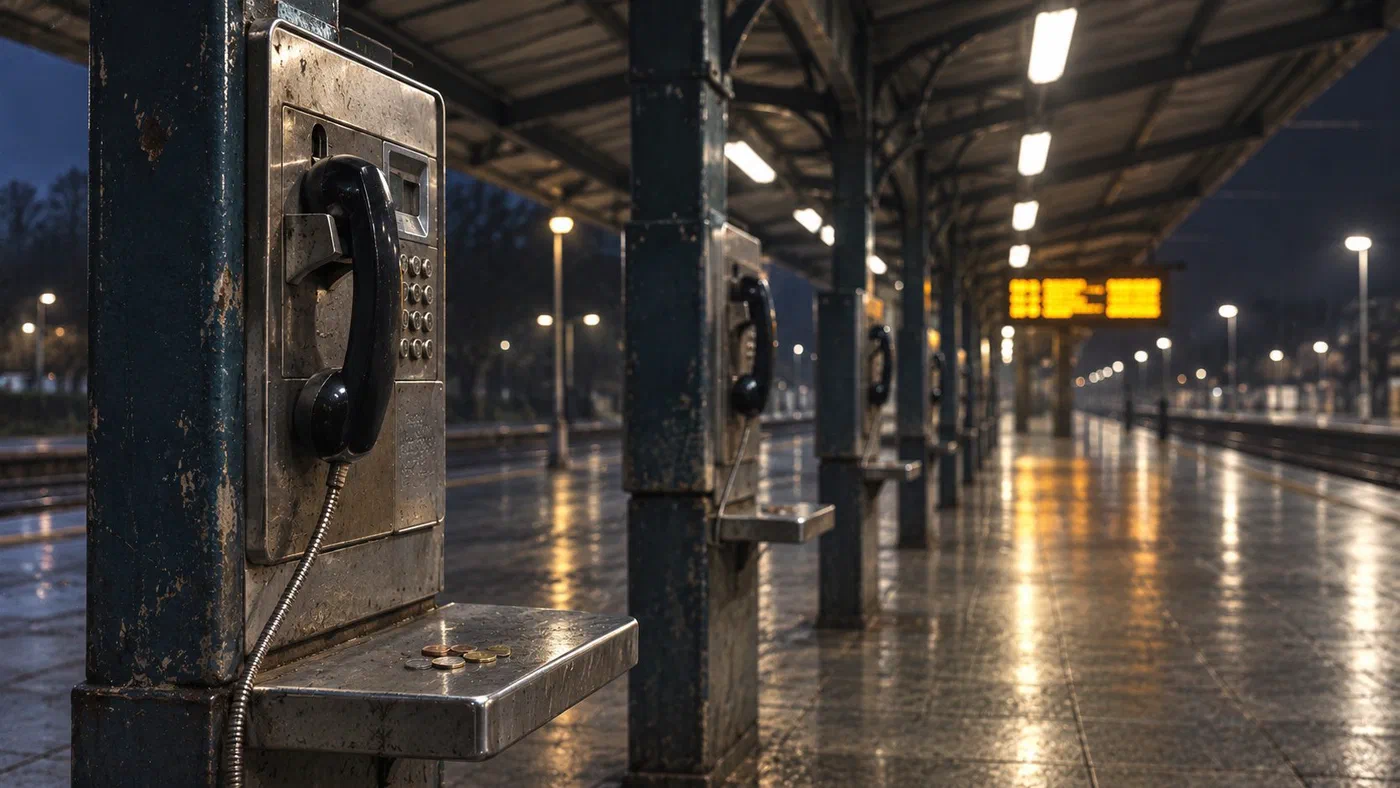
The corridors of the train station were empty and threatening. There were payphones everywhere — the same payphones where my brother and I would search for the change people left behind. It was our first time in Dortmund, Germany. And perhaps, a trip we shouldn’t have taken.
Amongst the flickering lights, we saw the station’s yellow departure board. The next train back to the airport was only in the morning. We were hours away from missing our flight to Milan — the kind of hours one wishes to count slowly, hoping to fit a miracle in.
A big town is no town in Germany at night. The lights were off, the restaurants and stores closed, and it was barely 10 at night. There was nowhere to go. The excitement of looking around the city was gone, killed by the black numbers on that bright yellow board.
Only a few souls walked around. When I saw two police officers nearby, I cried, “We were robbed. Help!” I screamed it from the inside out. I couldn’t explain it any differently. I could feel my face twisted in terror. I had asked at the station. I had made sure there would be a train back to the airport that night, and there wasn’t. They had sold the tickets anyway.
The policemen gave us the cold shoulder. I insisted.
“We have no money to get back to the airport. We’ll miss our flight,” I told them, hopeful. But their answer astonishes me to this day.
“There is nothing we can do,” they said, as if the whole saga we had just gone through because of the misinformation the ticket counter gave us did not matter.
The center was dark, distant — even though we were just a short walk away from its buildings. We looked around once more. I couldn’t properly perceive the size of the buildings, but their shadows stood not so far away. We watched them from the station, while I prayed and sought a miracle. Survival mode took over; I felt my blood rushing back to my heart.
“The payphones… payphones… we need to call our parents!” my brother cried, trying to catch my attention.
“And what could they do?” I immediately reminded him. Our parents were already asleep, an ocean away.
We swept the station like two rats in a trap looking for a way out. We needed to get back to that airport as soon as possible, and the cold had already begun to seep into the fabric of our coats. What were we to do? Where should we go?
I walked back to the policemen, who didn’t look pleased to see me again. “I need to go back to the airport!”
“Well…” one said, reluctantly. “I believe there is a van leaving the station for the airport at 3 a.m. You could try to catch that.”
This time, I prayed for it to be true — but it didn’t solve the main issue. We had no money left. All we had had been spent on two return tickets that guaranteed us no return.
“It is not so late. There are still a few people around. Perhaps, if we explain what happened, they will give us the money we need to pay for the van.”
“Are you silly — are you going to beg?” My brother stepped away from me. “I don’t know you!” “Pobreza…” he muttered. Slowly. My poor was showing. I walked toward the first person.
“You’re not gonna do it…”
“Can you think of anything better?” I inquired.
I asked for money once. I asked twice. I asked every single soul walking through that ratty, ominous station. Each time, I had my brother 10 steps away muttering in Portuguese, “pobreza… manifesta…”1 These were his two words for anything that was too enthusiastic to be dignified. I used to earn them on purpose, with whatever was at hand. That night, I wasn’t playing.
Nobody helped. One man ran from me as if I had a contagious disease transmitted by sight. I was properly dressed, but people seemed to fear me. Nobody even said a word. Was it because I didn’t know German or was the simple act of asking for money creepy enough? Was I wrong to mention I had been robbed? Or perhaps my brother should have been pushed a few more steps away from his peasant sister. His muttered words could be driving away the few people I found.
“The payphones… Mom and Dad need to send me money NOW! So we can pay for the van.”
That settled it. We could no longer protect the peaceful sleep our parents were probably having that night, but calling them was a challenge of its own. We walked to every payphone in that station, fishing in every coin return for forgotten change. And we were in luck!
“Dad, we’re in Dortmund… there is no time to explain, but we’re safe. We need some money in my bank account right now or we will miss our flight to Italy.”
I could almost hear my dad jump out of bed. “Rebeca, what happened? Aren’t you at the airport already? What are you doing in Dortmund?? Why did you leave the airport?” His questions wouldn’t cease.
“We had to fish for coins to call you. We took a train to Dortmund, but there is no train back until morning. All we had went on the train tickets. We need money to catch a van that leaves for the airport at 3 a.m.”
I fed more coins into the payphone.
“What are you both doing there? Why did you catch a train to Dortmund?”
Credits were ticking down. My hands were already feeding the machine every 5 seconds.
“I don’t have time to explain. I’ll call again when I can. Dad, please, just send the money.”
“What time is the van? Why did you go to…”
“Dad…”
I was racing the display. There were almost no coins left, and my father kept asking questions, more and more of them, in a panic.
I trusted the money would reach us in time, and we waited…
The van arrived at 3 a.m., as we expected.
“Sixty euros for you two,” the driver told us. I handed him my debit card, and there my hand stayed, hanging in the air.
“Cash only.”
“What?” I asked, as nervous as before. I hadn’t had the chance to calm down yet.
“Is there any ATM nearby?” I knew there wasn’t. Not at the station. And I had already filled my quota of insanities for the night. The nearest one meant diving into that city’s darkness for at least three miles.
The driver looked away, helping a family of Germans before us.
“Please, let us pay you once we get to the airport.”
“Cash now, or you can’t come,” he said harshly, already walking back to the driver’s seat. My brother and I stared at each other, and our eyes must have met in turmoil without either of us realizing.
“It’s gonna be alright,” we heard from one of that family’s members. We watched them step forward, saying something to the driver. I said nothing. They looked back at us. The glance wasn’t one of pity. Maybe, for the first time that night, my eyes had told the story I had been trying to verbalize all night, unsuccessfully.
Pobreza… manifesta… is Portuguese for “poverty… it’s manifesting…”, my brother’s running joke that a poor spirit was showing itself in me. ↩︎